


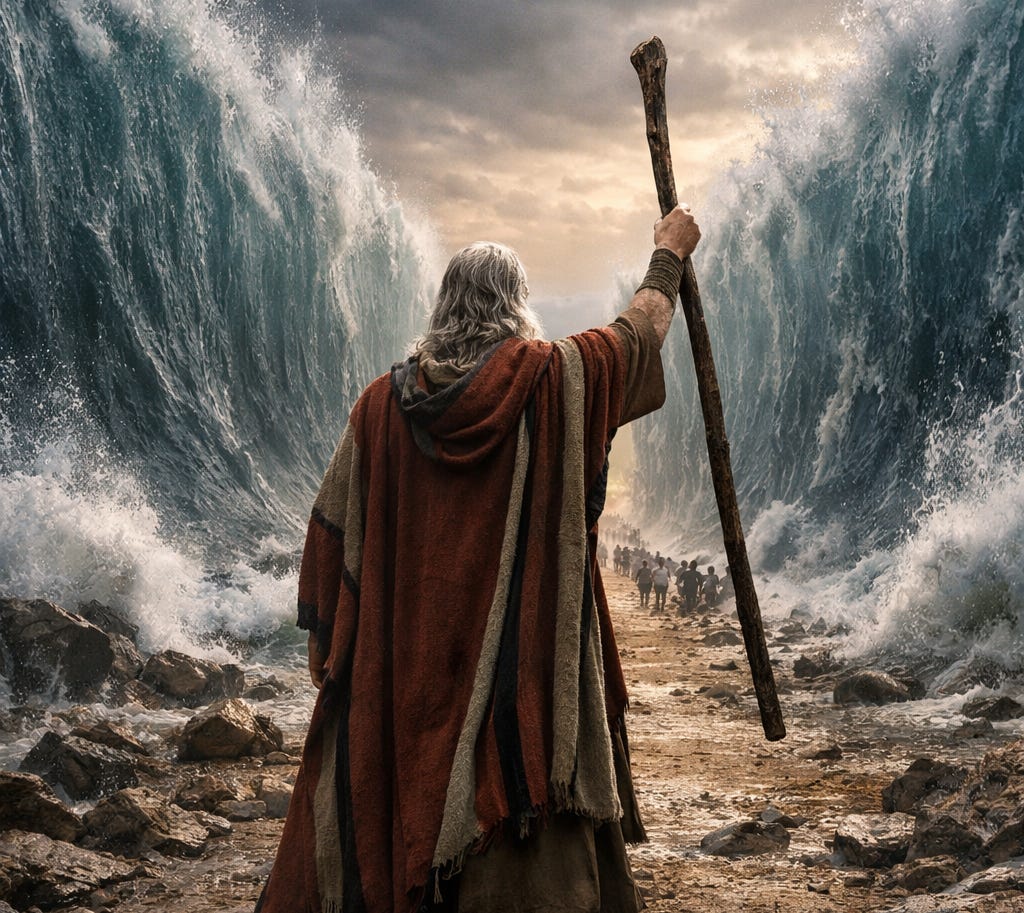
Leadership is rarely simple. Leading people who carry trauma, disappointment, and distrust can be one of the most demanding assignments God gives.
In Exodus 14, Israel stands at a defining moment. They had witnessed the ten plagues. They had seen Pharaoh yield. They had walked out of Egypt with visible evidence of God’s power. Humanly speaking, their confidence should have been unshakable.
Yet when Pharaoh’s army approached, Scripture says:
“When Pharaoh drew near, the people of Israel lifted up their eyes, and behold, the Egyptians were marching after them, and they feared greatly. And the people of Israel cried out to the Lord.”
— Exodus 14:10
Their cry sounded spiritual. But what followed exposed their hearts:
“Is it because there are no graves in Egypt that you have taken us away to die in the wilderness?”
— Exodus 14:11
They cried to the Lord, then blamed Moses. In blaming Moses, they implicitly blamed God. Trauma had shaped their imagination. They could envision slavery. They could envision death. They could not envision deliverance beyond what they had already seen.
They assumed God could lead them out of Egypt, but not through the sea.
What they did not know was that one of the greatest miracles in redemptive history was about to unfold.
And it did not happen in seconds.
Exodus tells us that:
“The Lord drove the sea back by a strong east wind all night and made the sea dry land.”
— Exodus 14:21
All night.
Between promise and breakthrough, there was a night of learning.
1. The Doctrine of Separation
Before the sea opened, something else happened:
“Then the angel of God… moved and went behind them… and came between the host of Egypt and the host of Israel.”
— Exodus 14:19–20
God Himself separated the two camps.
Deliverance required distinction.
Scripture consistently calls God’s people to visible separation from the patterns and values of the world (2 Corinthians 6:17). This is not isolation. It is consecration. It is clarity about allegiance.
At the Red Sea, Israel learned that God defends what belongs to Him. But they also learned that identity precedes breakthrough. A people who blur boundaries cannot expect clear direction.
2. The Discipline of Waiting
The sea did not split instantly. The wind blew all night.
We measure projects by two metrics: cost and time. How much will it take? How long will it take?
God’s economy is different.
We evaluate God’s work by our clock. But Scripture says:
“They who wait for the Lord shall renew their strength.”
— Isaiah 40:31
Waiting is not inactivity. It is formation.
In that long night, Israel had to stand still while the wind worked. Moses had already told them:
“Fear not, stand firm, and see the salvation of the Lord.”
— Exodus 14:13
Leadership often means holding position while heaven moves invisibly.
The wind may already be blowing, even when the path is not yet visible.
3. Trusting God’s Appointed Leadership
This is perhaps the most uncomfortable lesson for modern readers.
Israel questioned Moses’ competence and judgment. Yet Moses’ authority was not self-constructed. It was divinely appointed (Exodus 3–4).
The New Testament affirms that leadership in the church is ultimately God’s initiative:
“And he gave the apostles, the prophets, the evangelists, the shepherds and teachers.”
— Ephesians 4:11
And:
“Obey your leaders and submit to them, for they are keeping watch over your souls.”
— Hebrews 13:17
John Calvin writes in his commentary on Ephesians 4:11:
“Those whom the Lord has appointed to govern his Church are, as it were, his vicegerents; and whoever despises them rebels against God himself.”
This does not excuse abuse. Scripture condemns domineering leadership (1 Peter 5:3). But it does establish that spiritual authority is not crowdsourced. It is recognized, not manufactured.
Israel had to decide whether they would interpret their fear through suspicion, or through trust in the God who appointed Moses.
Leadership requires courage. Followership requires faith.
Both are tested at the sea.
4. Learning to Praise After Deliverance
After the crossing, Moses led the people in worship (Exodus 15:1).
Deliverance led to doxology.
In Luke 17:11–19, ten lepers were healed, but only one returned to give thanks. Gratitude distinguishes those who merely experience blessing from those who recognize grace.
It is possible to cross the sea and resume “normal life” without worship.
Moses understood something essential: miracles must be memorialized in praise, or they will be forgotten in routine.
Praise stabilizes memory. It teaches the next generation how God works.
Exodus 14 reminds us that fear is real, even for people who have seen God work before. Israel had witnessed the plagues, yet they still panicked when the army approached.
A Final word
You may be in a similar place. The past is behind you. The future feels blocked. The answer is not visible yet.
God did not abandon Israel in the night. He was working while they waited (Exodus 14:21). The delay did not mean absence.
If you are facing your own Red Sea:
Pray honestly.
Wait patiently.
Trust that God is at work even when you cannot see the outcome.
The Lord who made a way for Israel is still able to make a way for you.
This deeply moved me and reminded me that God is still working, even in the waiting.🙌🏼