


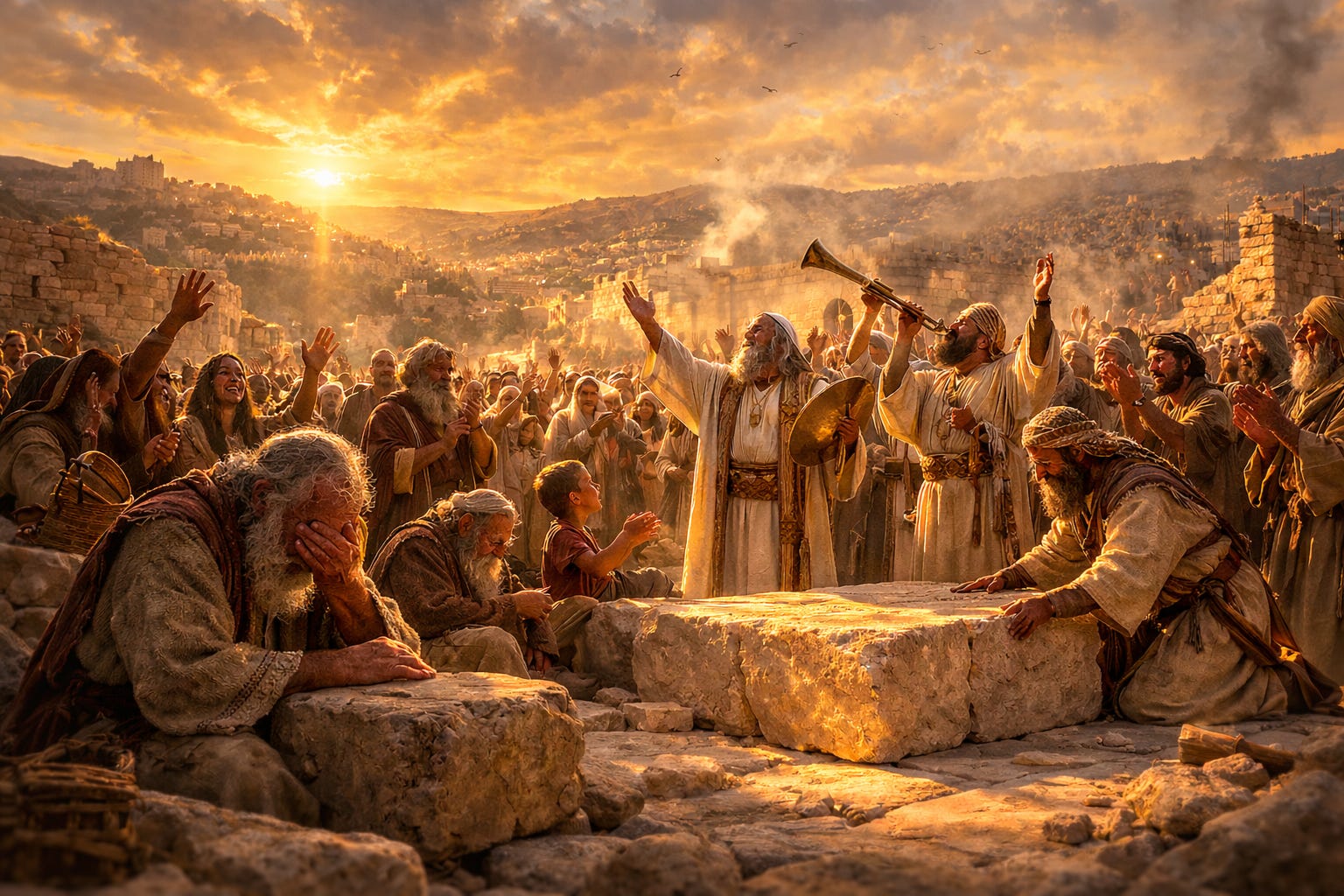
Last Sunday I preached from Ezra chapter 3. This chapter records one of the most significant moments in Israel’s history after the exile. The book of Ezra highlights two important leaders in this restoration period. Zerubbabel led the effort to rebuild the temple, while Ezra later focused on restoring the Law of Moses among the people.
For New Testament believers, the lives and experiences of God’s people in the Old Testament carry deep spiritual lessons. The apostle Paul reminds us that these things were written for our instruction. In 1 Corinthians 10:11, he writes, “Now all these things happened to them as examples, and they were written for our admonition, upon whom the ends of the ages have come.”
When Zerubbabel and Jeshua the priest laid the foundation of the new temple, the people responded in two different ways. Ezra tells us that some shouted for joy, while others, especially the older generation who had seen Solomon’s temple, wept loudly. Ezra 3:12–13 explains that the sound of weeping and rejoicing mixed together so that the people could not distinguish between them.
Some were looking toward the future with hope. Others were remembering the past with grief.
Yet beyond these emotional reactions lies a deeper question. Why was the temple so important for them, and what spiritual lessons can believers learn from this moment?
To answer that question, we must look back even further to the tabernacle.
God’s Presence Among His People
Before the temple existed as a permanent structure, God commanded Israel to build a mobile sanctuary called the tabernacle. In Exodus 25:8, God said, “Let them make me a sanctuary, that I may dwell among them.”
The tabernacle was not merely a religious symbol. It was the place where God chose to reveal His presence among His people. Scripture tells us that God spoke to Moses from the tent of meeting. Exodus 33:11 says, “So the Lord spoke to Moses face to face, as a man speaks to his friend.”
The visible presence of God rested upon the tabernacle. When the tabernacle was completed, Exodus 40:34–35 records that the cloud covered the tent of meeting and the glory of the Lord filled the tabernacle. The cloud remained over the tabernacle during the day, and fire appeared in the cloud at night so that all Israel could see it. This is described clearly in Exodus 40:38.
In many ways, the tabernacle represented the place where heaven and earth met. It was the visible reminder that God was dwelling among His people.
One of the most remarkable moments connected to God’s presence appears in Exodus 33. After the sin of the golden calf, God told Moses that He would still lead Israel into the promised land and defeat their enemies. However, He said that His presence would not go with them because their stubbornness could bring judgment upon them. Instead, He would send an angel before them. This is recorded in Exodus 33:2–3.
Moses responded by interceding for the people. Eventually, God said to Moses in Exodus 33:14, “My presence will go with you, and I will give you rest.”
Yet Moses did not accept this promise only for himself. He replied in Exodus 33:15–16, “If Your presence does not go with us, do not bring us up from here. For how then will it be known that Your people and I have found grace in Your sight, except You go with us? So we shall be separate, Your people and I, from all the people who are upon the face of the earth.”
Moses understood something deeply important. The true distinction of God’s people is not religion, morality, or knowledge. What makes God’s people different from the nations is the presence of God among them.
The apostle Paul echoes this same idea in the New Testament. In 1 Corinthians 14:24–25, he describes what should happen when an unbeliever enters the gathering of believers. The person becomes convicted by the truth and ultimately declares, “God is truly among you.”
God Must Be at the Center
Another powerful lesson from the tabernacle is the centrality of God.
In Numbers chapter 2, God instructed the twelve tribes of Israel how they were to camp during their journey through the wilderness. The arrangement was intentional. The tabernacle was placed at the center of the camp, and the tribes were positioned around it.
This structure visually communicated that God was to be at the center of the nation’s life. Their identity, direction, and unity all revolved around His presence.
The New Testament presents a similar truth. In Matthew 18:20, Jesus says, “For where two or three are gathered together in My name, I am there in the midst of them.”
Notice the phrase “in the midst.” Christ is not meant to be placed on the margins of our lives. He is meant to be at the center.
Many people think of their spiritual life as a list of priorities. They imagine something like this: God first, family second, work third, and other responsibilities after that. But this structure can unintentionally separate God from the rest of life.
A better way to think about it is as a circle rather than a list. At the center of that circle is Christ, and everything else in life connects back to Him. Our family life, work, ministry, education, and decisions all revolve around Him.
A practical test of this is simple. If removing Christ causes everything in our life to collapse spiritually, then He is truly at the center. But if life continues normally without Him, then He was never truly central.
Scripture reminds us that Christ is not only the beginning but also the end. In Revelation 22:13, Jesus declares, “I am the Alpha and the Omega, the Beginning and the End, the First and the Last.”
Life in This World Is Temporary
The image of the tent also reminds us that life in this world is temporary.
The apostles frequently used the imagery of a tent to describe the human body. In 2 Corinthians 5:1, Paul writes, “For we know that if our earthly house, this tent, is destroyed, we have a building from God, a house not made with hands, eternal in the heavens.”
Peter used the same language. In 2 Peter 1:13–14, he wrote, “Yes, I think it is right, as long as I am in this tent, to stir you up by reminding you, knowing that shortly I must put off my tent, just as our Lord Jesus Christ showed me.”
These passages remind believers that our present life is temporary. Our bodies are like tents rather than permanent homes.
Yet there is also great hope for believers. Through salvation we are sealed with the Holy Spirit. Ephesians 1:13–14 explains that believers are sealed with the Holy Spirit of promise, who is the guarantee of our inheritance until the redemption of the purchased possession.
One day believers will receive new, glorified bodies. Paul speaks of this future transformation in 1 Corinthians 15:42–44, where he explains that the body that is sown in corruption will be raised in incorruption, and the natural body will be raised a spiritual body.
The resurrection body of Christ provides a glimpse of this future reality. After His resurrection, Jesus appeared to His disciples, spoke with them, and even ate with them, as described in Luke 24:36–43 and John 20:26–29.
The point of these teachings is not simply to make believers curious about the future body. The main lesson is that believers should not attach their hearts to a fallen world that is temporary. Hebrews 13:14 reminds us, “For here we have no continuing city, but we seek the one to come.”
A Life of Readiness
Another important feature of the tabernacle was movement. Israel did not travel according to their own plans. They moved only when the presence of God moved.
Numbers 9:17–18 explains that whenever the cloud was taken up from above the tabernacle, the children of Israel would journey. But when the cloud remained, they stayed where they were. The people watched the cloud carefully so they would know when to move.
This required constant readiness. The people had to remain attentive to the movement of God’s presence.
Scripture gives a similar example in the life of Abraham. When God commanded him to sacrifice Isaac, Genesis 22:3 records that Abraham rose early in the morning and began the journey that God had commanded.
There was no hesitation and no delay.
True obedience requires readiness. It requires a heart that is willing to respond when God calls.
Augustine wrote, “You have made us for Yourself, O Lord, and our heart is restless until it rests in You.”
John Calvin observed that the structure of the tabernacle reminded Israel that God had chosen to dwell in the midst of His people.
Charles Spurgeon once said, “Without the presence of God, the church is nothing more than a gathering of people; but with His presence it becomes the dwelling place of heaven on earth.”
Conclusion
When the foundation of the temple was laid in Ezra 3, the people responded with both joy and grief. Yet the deeper issue was never the building itself. The temple mattered because it represented something far greater. It represented the presence of God among His people.
The tabernacle and the temple remind us of several enduring spiritual truths. God desires to dwell among His people. His presence must remain at the center of our lives. Life in this world is temporary, and believers must live in readiness to obey Him.
The question every believer must ask is simple. Are we building our lives around the presence of God?
If we discover that we are not, it is never too late to restore what truly belongs at the center.