



Most churches do not wake up one morning and decide to abandon Scripture. Spiritual decline is usually much quieter than that. It happens through decisions that appear reasonable at the time: a difficult conversation is postponed, a biblical conviction is softened, a destructive pattern is tolerated because confronting it might divide people, or a ministry standard is quietly adjusted because maintaining it has become inconvenient.
None of those decisions necessarily feels like rebellion. In fact, they can sound pastoral, diplomatic, strategic, and even compassionate.
That is precisely what makes the opening chapters of the Book of Judges so uncomfortable for anyone involved in church leadership.
There is a phrase repeated throughout Judges 1 that is easy to overlook:
“They did not drive them out.”
Initially, it sounds like a military detail. Israel entered the land God had promised them, encountered resistance, and failed to complete the conquest. Yet when we continue reading into Judges 2 and 3, we discover that something deeper was happening. Israel’s greatest problem was not simply that they could not remove the nations around them. Increasingly, they became willing to live with what God had told them to confront.
That distinction matters because what Israel tolerated in one generation eventually reshaped the faith of the next.
And the same thing can happen in a church.
How Does Spiritual Compromise Actually Begin?
God had given Israel clear instructions concerning the inhabitants of Canaan. They were not to enter covenants that would lead them into idolatry, and they were commanded to tear down the pagan altars in the land.
Yet Judges 1 describes tribe after tribe allowing the Canaanites to remain.
We can easily imagine how reasonable this must have seemed. Why continue fighting when peaceful coexistence was possible? Why remove people who could contribute economically? Why create another costly conflict when an arrangement could be reached that benefited everyone?
Israel may even have considered this wisdom.
God called it something else.
When the Angel of the LORD confronted them, He said:
“Ye have not obeyed my voice: why have ye done this?”
— Judges 2:2
Notice that God did not primarily describe their problem as military weakness. He identified it as disobedience.
This is one of the first leadership lessons Judges gives us: compromise rarely announces itself by saying, “Disobey God.” More commonly, it asks whether obedience is really necessary under the present circumstances.
For church leaders, that temptation can appear in many forms. We may call something cultural sensitivity when part of the issue is actually fear of offending people. We may call something patience when we have simply postponed a necessary confrontation for several years. We may describe a decision as strategic when the truth is that obedience would cost us attendance, money, influence, or relationships.
There is such a thing as legitimate flexibility in ministry. Paul himself adapted his approach for the sake of reaching different groups of people (1 Corinthians 9:19–23). Yet biblical flexibility always has a boundary.
We can change our methods in order to reach people, but we cannot change our obedience in order to keep them.
What Happens When a Church Learns to Live With Compromise?
God warned Israel that the people they allowed to remain would eventually become a snare to them (Judges 2:3). By Judges 3, that warning had already begun to materialize.
Israel was no longer merely living alongside the nations. Their sons and daughters were marrying into them, and eventually Scripture tells us that Israel “served their gods” (Judges 3:6).
The progression is significant because Israel did not move directly from covenant faithfulness to idolatry. Their transformation happened gradually. Coexistence led to accommodation, accommodation influenced identity, and eventually their changing identity affected their worship.
Churches often drift in much the same way.
A congregation does not need to rewrite its doctrinal statement in order to become spiritually unhealthy. It can continue affirming the inspiration of Scripture, the deity of Christ, salvation by grace, and the resurrection while gradually adopting a completely different set of values in practice.
Success begins to mean numbers rather than discipleship. Leadership becomes associated with visibility rather than character. Protecting the reputation of the ministry becomes more important than confronting wrongdoing. Difficult biblical teachings receive less attention because leaders know certain subjects will create discomfort.
Eventually the church may still possess orthodox language while developing a culture shaped by assumptions that came from somewhere else.
This is why Paul’s warning in Romans 12:2 remains so important: “Be not conformed to this world: but be ye transformed by the renewing of your mind.”
Worldliness does not enter the church only through obvious immorality. Sometimes it enters through our definition of success.
What One Generation Tolerates, the Next Generation May Normalize
Perhaps the most frightening verse in these opening chapters appears in Judges 2:10:
“And there arose another generation after them, which knew not the LORD, nor yet the works which he had done for Israel.”
Every pastor should spend some time with that verse.
This was not a generation living centuries after Joshua. Their parents and grandparents belonged to the generation that had witnessed extraordinary acts of God. The crossing of the Jordan, the conquest of Jericho, and the provision of God were part of Israel’s living memory.
Yet somehow a generation arose that did not truly know the Lord.
That is where Judges forces church leaders to think beyond the immediate consequences of our decisions.
When leaders face difficult issues, we naturally ask questions such as: Will people leave? Will this create division? Will this affect attendance? Will donors misunderstand us? Will confronting this behavior create unnecessary conflict?
Those questions are understandable, but there is another question we do not ask nearly enough:
What kind of Christians will our present leadership produce twenty years from now?
A leader can preserve temporary peace while unintentionally creating long-term weakness. Sometimes what looks like peace is simply the absence of confrontation because everyone has learned that certain subjects should not be discussed.
The responsibility of Christian leadership is therefore larger than maintaining the congregation we presently have. We are helping shape the spiritual assumptions of people who will eventually lead the church after us.
What one generation tolerates, the next generation may no longer recognize as compromise.
Can a Church Be Welcoming Without Losing Its Identity?
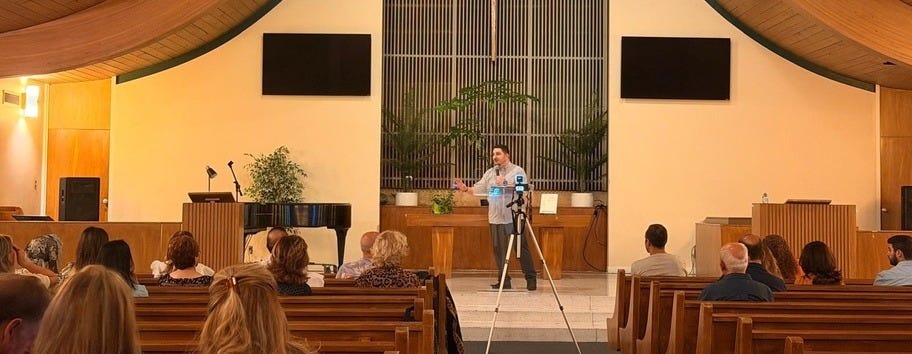
This question becomes especially important when we think about church membership and evangelism.
The church should be deeply welcoming to people who do not yet believe. We should want people who are far from God to enter our gatherings, hear the gospel, experience Christian hospitality, ask difficult questions, and see a community shaped by the love of Christ. Paul clearly anticipated unbelievers being present in Christian gatherings in 1 Corinthians 14:23–25.
But welcoming someone into a gathering is not the same thing as recognizing that person as belonging to the covenant community.
The New Testament maintains this distinction. Following the sobering account of Ananias and Sapphira, Acts tells us that people highly regarded the Christians, yet there was also a seriousness attached to joining them (Acts 5:11–14). Paul likewise distinguishes between those “inside” and those “outside” the church when addressing church discipline in 1 Corinthians 5:12–13.
The early church retained this understanding. Polycarp instructed church elders to be “compassionate and merciful to all, bringing back those that wander.” His vision of leadership was neither careless permissiveness nor severe authoritarianism; pastors were expected to guard the community while actively pursuing those who wandered.
That balance remains essential.
A church should be a place where sinners are welcomed, but it should also be a community where repentance matters. Evangelism says, Come and hear about Christ. Membership says, Together we confess that we belong to Christ.
When those two things are confused, a church can gradually become so concerned about being welcoming that it becomes unable to explain what Christian belonging actually means.
When Does Relevance Become Worldliness?
Every generation of Christians has to answer the question of cultural relevance.
Our language can change. Our musical styles can change. Our technology can change. The architecture of our buildings can change, and many ministry methods that were effective fifty years ago may no longer be effective today.
None of that threatens the gospel.
The danger begins when the desire to communicate with the culture becomes a willingness to be governed by the culture.
Martin Luther understood that genuine reformation could not ultimately be produced by personality or force. Looking back on the upheaval surrounding the Reformation, he famously said:
“I did nothing; the Word did everything.”
There is something deeply important for modern church leaders in that statement.
We have access to leadership conferences, marketing strategies, social media platforms, church-growth models, demographic research, sophisticated technology, and organizational systems that previous generations could hardly have imagined. Many of these things are useful.
But none of them can reform the church.
Only the Word of God has the authority to continually bring the church back under the lordship of Christ.
Sometimes we use Scripture to support decisions we have already made. Genuine reformation occurs when we give Scripture permission to challenge those decisions.
Have We Forgotten Why God Delivered Us?
There is another issue beneath Israel’s compromise that may be even more important.
Israel gradually forgot why they had been delivered in the first place.
When Moses confronted Pharaoh, God’s message was not simply, “Let My people go so they can enjoy freedom.” Again and again, God declared:
“Let my people go, that they may serve me.”
— Exodus 8:1
Their liberation had a purpose. God was creating a people who would worship Him, represent His character, and become a witness among the nations.
Yet by the opening chapters of Judges, the Promised Land increasingly appears to have become an end in itself. Israel wanted homes, fields, security, families, and stability. The blessings God had given them remained, but the purpose behind those blessings was slowly disappearing.
Churches can make precisely the same mistake.
A congregation may gradually begin to believe that the church exists primarily to provide good preaching, enjoyable worship, meaningful friendships, children’s programs, pastoral care, and a comfortable Sunday experience. All of those things have value, but none of them represents the ultimate purpose of the church.
Peter reminds believers that they are “a chosen generation, a royal priesthood, an holy nation” precisely so that they might proclaim the praises of the One who called them out of darkness into His marvelous light (1 Peter 2:9).
God does not simply call a people out. He also sends a people out.
The church gathers for worship, grows through discipleship, and scatters for mission. When mission disappears, comfort naturally becomes increasingly important; and once comfort becomes one of the church’s highest values, compromise begins to look surprisingly reasonable.
Five Questions Every Church Leader Should Ask
The question the Angel of the LORD asked Israel “Why have ye done this?” is a valuable question for pastors, elders, ministry directors, and Christian leaders to regularly bring before God.
Before moving on from Judges 1–3, I would suggest sitting with these five questions:
What has our church gradually learned to tolerate that we once recognized as spiritually dangerous?
Where have I confused avoiding conflict with exercising biblical wisdom?
Are we measuring success primarily through attendance, finances, visibility, and activity, or through discipleship, holiness, mission, and faithfulness?
If our present patterns continue for another twenty years, what kind of Christian leaders will they produce?
Is there something God has already made clear in His Word that I keep postponing because obedience will be costly?
These questions are not intended to make leaders suspicious of every change or fearful of the culture around them. The church is called to enter the world with confidence, compassion, creativity, and missionary courage.
But entering the culture is very different from allowing the culture to redefine us.
Judges begins with what appears to be incomplete obedience, yet incomplete obedience does not remain a small matter for very long. It eventually reshapes relationships, then values, then worship, and finally an entire generation.
That may be the warning church leaders most need to hear from the opening chapters of Judges:
Compromise rarely asks us to abandon God today. More often, it asks us to tolerate today what may cause the next generation to forget Him tomorrow.
And before asking whether our churches are successful, relevant, growing, or influential, perhaps we should recover the question God asked His people thousands of years ago:
Are we obeying Him?
compromise rarely announces itself by saying, “Disobey God.” More commonly, it asks whether obedience is really necessary under the present circumstances.
Great point and very important message nowadays 🙌🏼